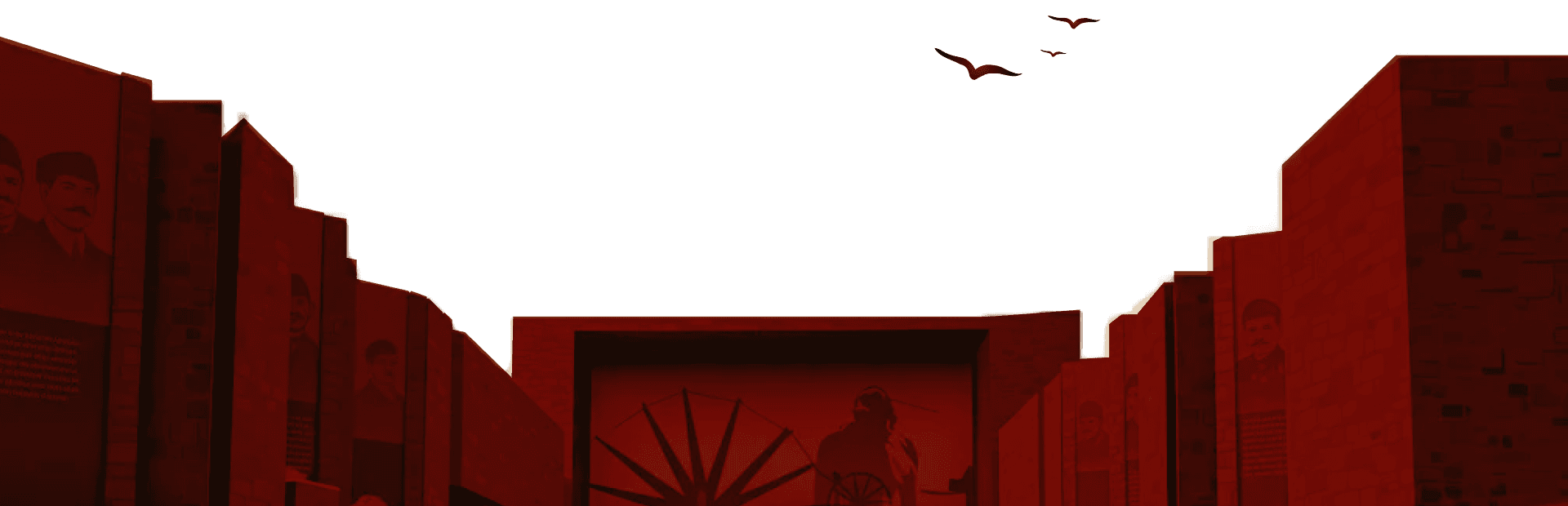
This memorial stands to honour their journey, a quiet reminder that the freedom we enjoy today was shaped by their strength, and that it is now our responsibility to carry their values forward.
A Life Led by Truth and Non-Violence
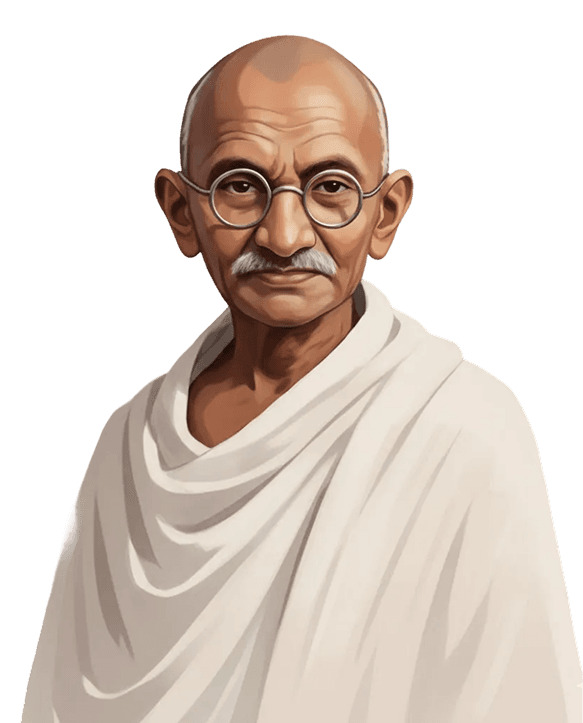
Mahatma Gandhi
His belief in Satyagraha, compassion, and moral courage fundamentally transformed India’s freedom struggle, offering the world a profound new way to confront injustice. This calm, principled leader championed a resistance that was firm yet resolutely non-violent, rooted in discipline and deep respect for humanity. By making truth and non-violence the binding tenets of the movement, he forged unity across diverse communities. His enduring legacy continues to resonate globally, influencing public life and movements for freedom around the world.
Yet, the fight for independence was not carried by one voice alone. The memorial also pays tribute to the diverse voices, movements, and sacrifices that together forged the nation.
Mahatma Gandhi
The foremost leader of India’s independence movement, he pioneered Satyagraha and non-violence, unifying the nation in a moral struggle for truth and freedom that remains a global inspiration for justice.
Pt. Jawaharlal Nehru
India’s first Prime Minister, visionary statesman, and freedom fighter who led India to independence and laid the foundations for democratic governance and industrial growth.
Subhash Chandra Bose
A charismatic leader who formed the Indian National Army and challenged British rule through armed resistance and international alliances.
Sardar Vallabhbhai Patel
The “Iron Man of India,” who played a pivotal role in integrating princely states and strengthening India’s political unity.
Chandra Shekhar Azad
Fearless revolutionary leader who orchestrated guerrilla warfare against British forces and vowed never to be captured alive, symbolizing uncompromising resistance.
Bal Gangadhar Tilak
Renowned nationalist and radical leader who popularized the slogan “Swaraj is my birthright,” catalyzing assertive mass movements against British colonialism.
Lala Lajpat Rai
A prominent nationalist, lawyer, and freedom fighter known as “Punjab Kesari,” he advocated self-rule and resistance against British oppression through activism and writing.
Lal Bahadur Shastri
India’s second Prime Minister, remembered for his humility and leadership during times of war and peace, and for the enduring call of “Jai Jawan, Jai Kisan.”
Dr. Rajendra Prasad
The first President of independent India, he played a key role in the freedom struggle and constitutional development, fostering unity in a diverse nation.
Dr. B.R. Ambedkar
The principal architect of India’s Constitution, a social reformer and champion of equality, who fought caste discrimination and upheld democratic values.
Gopal Krishna Gokhale
A senior leader in the Indian National Congress, Gokhale advocated constitutional reforms, social justice, and education, shaping India’s political awakening and freedom movement.
Maulana Abul Kalam Azad
Scholar, freedom fighter, and India’s first education minister, Azad championed secularism, national unity, and educational reforms for a free India.
Rani Lakshmi Bai
The queen of Jhansi and iconic heroine of the 1857 Rebellion, who led her troops valiantly in armed struggle against British annexation.
Mangal Pandey
The Indian soldier whose actions in 1857 sparked the First War of Indian Independence, symbolising early armed resistance to colonial rule.
Bhagat Singh
Revolutionary socialist whose daring acts against British authorities and martyrdom electrified the youth and intensified the call for complete independence.
Dadabhai Naoroji
Known as the “Grand Old Man of India,” he exposed British economic exploitation and advocated for Indian political rights in British Parliament.
Nana Saheb
Leader of the 1857 rebellion in Kanpur, who opposed British rule and organised significant revolutionary resistance during India’s First War of Independence.
Rani Abbakka Chowta
The fearless 16th-century Queen of Ullal, Karnataka, who resisted Portuguese colonisers and pioneered early anti-colonial naval defence, exemplifying women’s leadership in resistance movements.
Kittur Rani Channamma
The early 19th-century queen of Kittur, who led armed resistance against British annexation, symbolising grassroots opposition to colonial rule and inspiring future freedom fighters.
Vinayak D. Savarkar
A freedom fighter and writer who contributed to India’s independence movement through revolutionary activism and political thought.
Kadidal Manjappa
A prominent freedom fighter from Karnataka who later served as Chief Minister, contributing to post-independence governance and reform.
Beyond these legends, countless unsung souls wove the fabric of India’s freedom.